

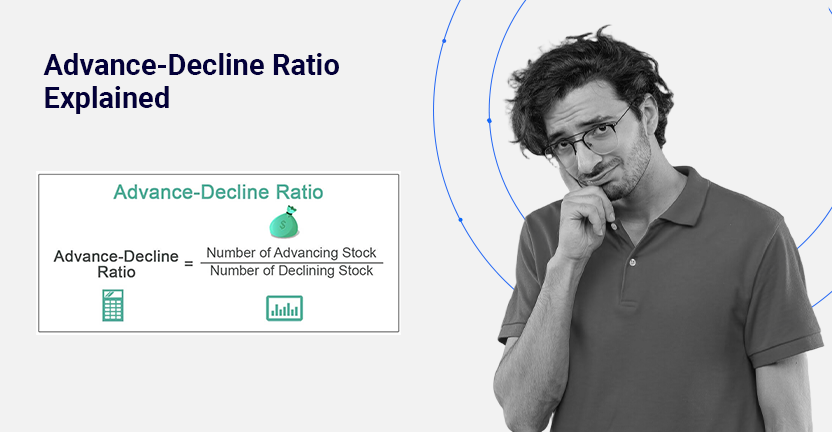
The Advance-Decline Ratio (ADR) is a market breadth indicator that helps traders and investors analyse the overall market trend. It compares the number of advancing stocks (gaining value) to declining stocks (losing value), providing insights into the strength of market movements. A consistently high ADR suggests a bullish market, while a low ADR may indicate market weakness or bearish sentiment. Tracking ADR is essential for traders to confirm trends and identify potential reversals.
In this blog, we will explore what the Advance-Decline Ratio is, how it is calculated, its importance in NSE trading, and how traders can use it to enhance their strategies.
What is the Advance-Decline Ratio?
The Advance-Decline Ratio (ADR) is a technical indicator that compares the number of stocks that have advanced in price to those that have declined over a specific period. It helps traders measure market participation and determine whether market trends are broad-based or concentrated in a few stocks.
Key Features of ADR:
- Evaluate market sentiment by analysing advancing vs. declining stocks.
- It helps confirm trends—a rising ADR supports a bullish trend, while a falling ADR signals weakness.
- Works across different indices, including NSE, BSE, Nifty 50, and broader market indices like Nifty 500.
ADR benefits traders looking to validate price movements and avoid false breakouts or misleading signals.
How to Calculate the Advance-Decline Ratio?
The Advance-Decline Ratio (ADR) is calculated using the formula:
ADR=Number of Advancing Stocks/Number of Declining Stocks
Example Calculation:
On a given trading day:
- 650 stocks on NSE increased in price (advancers).
- 450 stocks declined in price (decliners).
ADR=650/450=1.44
What Does the ADR Value Indicate?
| ADR Value | Market Sentiment | Interpretation |
| Above 1 | Bullish | More advancing stocks than decliners, indicating market strength. |
| Equal to 1 | Neutral | Advancers and decliners are balanced, showing market indecision. |
| Below 1 | Bearish | There are more declining stocks than advancers, suggesting market weakness. |
A rising ADR over multiple trading sessions confirms an uptrend, while a falling ADR signals deteriorating market conditions.
Why is the Advance-Decline Ratio Important?
The Advance-Decline Ratio (ADR) is a leading indicator that helps traders gauge market strength before price movements occur.
1. Confirms Market Trends
A strong bullish trend is validated when ADR remains consistently above 1. If ADR starts falling while prices continue rising, it may indicate a weakening trend.
2. Identifies Trend Reversals
If ADR drops below one after a prolonged uptrend, it suggests that the market is losing momentum. Traders use this signal to adjust their positions.
3. Works Across Different Timeframes
ADR can be applied to:
- Intraday trading – To track short-term sentiment shifts.
- Swing trading – To confirm bullish or bearish trends over weeks.
- Long-term investing – To assess market health over months.
By analysing ADR trends, traders and investors can make better trading decisions.
How is the Advance-Decline Ratio used in NSE Trading?
The Advance-Decline Ratio is widely used in the National Stock Exchange (NSE) to track market breadth across indices like:
- Nifty 50 – The top 50 NSE-listed companies.
- Nifty 500 – A broader market index tracking 500 stocks.
- Sectoral Indices – ADR can also be applied to individual sectors like IT, banking, and FMCG.
By monitoring ADR for these indices, traders gain valuable insights into market trends and sector-specific performance.
How is ADR used in Trading Strategies?
Traders use ADR alongside other technical indicators to refine their strategies:
1. Trend Confirmation Strategy
- If ADR is above one and increasing, it confirms a bullish trend.
- If ADR is below one and decreasing, it confirms a bearish trend.
2. Divergence Strategy
- If the index is rising but ADR is falling, it suggests that fewer stocks are driving the rally, which could signal an impending correction.
- If the index falls but ADR rises, it indicates potential accumulation and a trend reversal.
3. Support and Resistance Strategy
- If ADR bounces from 1 multiple times, it suggests strong market support.
- If ADR fails to break above 1, it indicates weak resistance and potential downside.
Using ADR combined with volume analysis, moving averages, and RSI improves accuracy in trading decisions.
Making Data-Driven Trading Decisions with ADR
The Advance-Decline Ratio (ADR) is an essential market breadth indicator that helps traders analyse sentiment, validate trends, and anticipate reversals. Whether tracking ADR on NSE, BSE, or broader indices, understanding its movements enhances trade timing and risk management.At Streetgains, we provide data-driven market research and technical analysis to help traders effectively interpret ADR trends and optimise their trading strategies.
Disclaimer:
The content in this blog is intended for informational purposes only and does not constitute investment advice, stock recommendations, or trade calls by Streetgains. The securities and examples mentioned are purely for illustration and are not recommendatory.
Investments in the securities market are subject to market risks. Please read all related documents carefully before investing.
Advance-Decline Ratio (ADR): Meaning & Calculation FAQs:
The Advance-Decline Ratio (ADR) is calculated by dividing the number of advancing stocks by the number of declining stocks in a given period.
ADR=Number of Advancing Stocks/Number of Declining Stocks
A value above 1 indicates bullish sentiment, while below 1 signals a bearish trend.
ADR helps traders and investors gauge market breadth by showing whether market movements are driven by a broad group of stocks or just a few large-cap stocks. A consistent ADR trend strengthens the reliability of an ongoing market direction.
- High ADR (above 1): More advancing stocks, indicating a strong, broad-based rally.
- Low ADR (below 1): More declining stocks, suggesting weakness and bearish momentum.
ADR near 1: The market is balanced with no clear trend
- ADR is a ratio-based indicator that compares advances to declines.
- ADL (Advance-Decline Line) is a cumulative measure that tracks the net number of advancing stocks over time.
- ADR provides short-term market sentiment, while ADL helps identify long-term trends.
Yes, traders look for ADR divergence—if ADR starts falling while prices rise, it suggests weakening momentum and a potential reversal. Similarly, a rising ADR with falling prices may indicate a market bottom and upcoming recovery.
Real-time ADR data is available on NSE and BSE websites, stock market apps, and financial platforms like Bloomberg and Moneycontrol. Traders can use these sources to track intraday and historical ADR trends.
At Streetgains, we provide market research, technical analysis, and trend insights to help traders interpret ADR data and apply it in strategic trade execution. Our research ensures traders make informed, data-backed decisions in different market conditions.
FAQs:
-
1. How to earn money daily from trading?
Earning money daily from trading involves strategies like day trading, where traders capitalise on small price movements within the same day. Success requires real-time market analysis, quick decision-making, and risk management.
-
2. How to earn money from equity trading?
To earn money from equity trading, you need to buy stocks at a lower price and sell them at a higher price. Success depends on researching companies, analysing stock trends, and using technical or fundamental analysis.
-
3. How to earn money from share trading in India?
In India, share trading offers profit potential through buying and selling stocks on exchanges like the NSE and BSE. To maximise returns, traders should use market research, tools like technical analysis, and risk management strategies.
-
4. How to make money from share trading in India?
Making money from share trading involves selecting the right stocks, timing the market, and implementing trading strategies like swing trading or day trading while staying informed about market trends.
-
5. How to transfer money from a trading account to a bank account?
To transfer money from your trading account to your bank, log into your trading platform, navigate to the funds section, and initiate a withdrawal request. The money will typically be credited to your linked bank account in 1 to 3 days.
-
6. How to withdraw money from a trading account?
You can withdraw funds by logging into your trading account, selecting the withdrawal option, and selecting the amount to transfer to your bank account. Ensure your bank account is linked and follow any steps your broker requires.
Want Daily Stock Recommendations That Are Generated By Our Analysts ?
Join 3 Lakh+ Investors who have tried our Services